
How to Actually Run Two Amps in Stereo (And the Mistakes That Wreck It)
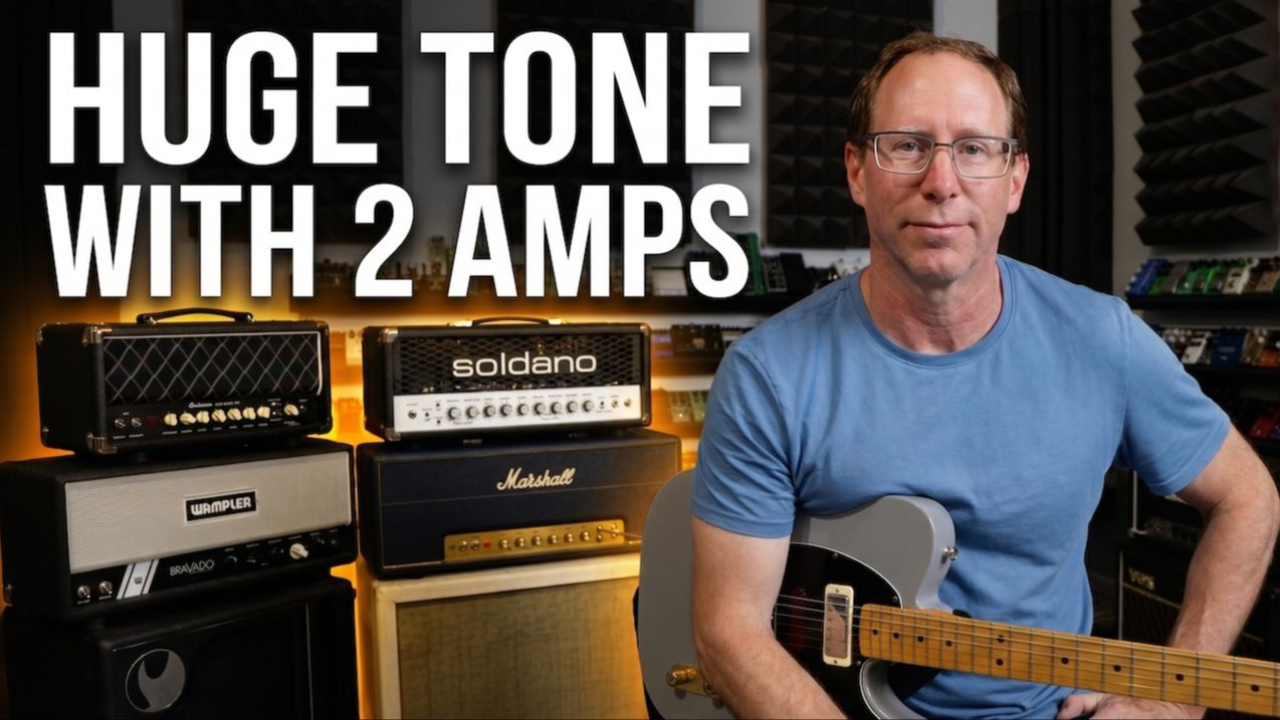
There is a specific guitar sound on records that most players never get out of their own rig. It's wide, it has air around it, and the guitar feels like it's living and breathing inside the entire room. You hear it and you might figure that your two-amp setup should do that. Then you plug in at home and it sounds boring and roughly the same as it did with one amp
Contrary to what some believe, running two amps does not automatically give you stereo. There is a certain signal flow work that has to happen, and there are specific effects moves that turn two amps into actual stereo separation. There are also a couple of mistakes that will make your tone sound worse than running one amp by itself.
Let's talk about who might actually want this first.
"Why would I ever want a stereo rig?"
Stereo guitar setups are mostly for three situations. Bedroom playing where you are running headphones or decent monitors, recording, and stadium-level live shows that actually run a true stereo PA. If you are gigging clubs and bars, you can run a stereo rig if you want, but the crowd is generally not going to notice... but as I always say, "it's not for them... It's for me!" Most club PAs are summed to mono at the front of house, so whatever stereo you build on stage collapses by the time it hits the audience. As a player, it still sounds massive on stage, and it's fun to play.
If you are sitting at home and want your playing to sound massive in your own ears, this is for you. Most of this applies to recording too, though the recording techniques around capturing stereo guitar have their own quirks that probably need a separate write-up.
One more thing before we get into it. If you are reading this and watching the video on your phone speaker, you are not going to hear any of it. Headphones or actual monitors are the only way to evaluate what stereo is doing.
The Signal Flow That Works REALLY Well For This
Most players who try a two-amp rig run it the obvious way. They take the effects loop send out of amp one and plug it into the input of amp two (oof!). That may seem reasonable. It is also the move that sounds *terrible* when done this way.
Why does that happen? Good question! When you take a signal out of the effects loop send, you are taking it after the preamp. That preamp'ed signal already has the color, the gain structure, and the voicing of amp one's preamp baked in. When you run that into the input of amp two, you are sending a preamp-shaped signal into another preamp with it's own shaped signal. Two preamps stacked. The result is almost always thin, brittle, and missing mids. Some amps cope with it better than others, but you are fighting the design. Think of it like scooping the mids with an eq pedal, running that into a second eq pedal and scooping those mids too. (oof again!)
The right move is to run from the effects loop send into the effects loop return of amp two. That bypasses amp two's preamp and uses just its power amp section. Now you have one preamp, two power amps, two speakers. That is the foundation of a clean stereo rig.
There is still a problem to solve. Two power amps almost never put out the same volume at the same input level. You will end up with one side louder than the other and your stereo image will be lopsided. The fix is to put a preamp or a booster between the split and amp two so you can dial in the level. A simple clean booster usually does the job.
Watch out for one thing here. Some boosters flip the phase of the signal. The EP Booster from Xotic is a great-sounding pedal and it flips phase. If you put it on one side of a stereo rig, that side is now out of phase with the other. Worse, if you are clicking it on and off mid-song, your stereo image is collapsing and re-opening every time you hit the switch. Test for this before you commit to a booster in a stereo rig. Plug it in, listen to both amps together with the booster on and with it off, and pay attention to whether the low end disappears or the tone sort of sounds hollow. That is phase cancellation, and that is your sign to swap in a different booster.
How to Actually Make It Sound Stereo
Once your signal flow is sorted, the next question is what to put in the path to create the stereo image. Here are five moves that work, ordered from easiest to most interesting.
Use a Stereo Doubler
The TC Electronic Mimic is built to do exactly what we are trying to do here. It takes a mono signal and creates a stereo doubled version of it. Plug it in, send the outputs to your two amps, and you immediately get separation that sounds like two takes of the same guitar part panned hard left and right. This is one of the easiest ways to get an obvious stereo result without doing anything tricky. If you have never run stereo before and you want to hear the difference right away, this kind of pedal will do it.
Chorus, Two Ways
Chorus is where most players naturally land when they hear about stereo guitar. There are two ways to use it.
The first way is to run chorus on one amp only. The other amp stays completely dry. That gives you a contrast between the modulated side and the clean side, and your brain reads it as wide. The catch is phase. Depending on the chorus pedal and the amps involved, the wet side and the dry side can end up out of phase with each other. When that happens, the tone goes hollow and small instead of big and wide.
A lot of stereo-capable chorus pedals have a phase flip switch built in. The Arion stereo chorus is one example. If you set up a wet-on-one-side rig and it sounds wrong, the first thing to check is the phase switch.
The second way is true stereo chorus, where both amps get the wet signal but the modulation is offset between them. That is a lusher, more immersive sound. It is not better or worse than the wet-dry approach, it is just a different feel. The wet-dry method feels like the chorus is sitting in space next to the dry guitar. The true stereo method feels like the whole sound is shimmering.
The Short Delay Trick
This is the move most guitar players have never heard explained, and it is one of my favorite ones personally.
Run a delay on one of the amps. Not a ping-pong. Not a long delay. Set the delay time as short as it will go, ideally 10 to 20 milliseconds, with the feedback all the way down. Use the most neutral, uncolored delay you have. The result is not an audible delay. It is a separation effect. Your ear cannot pick out a repeat at that timing, but your brain reads the two amps as occupying different positions in space. The whole sound stretches out.
This trick comes straight from recording. When an engineer puts two SM57s on a guitar cab and pans them left and right, they will often delay one of the mics by a few milliseconds to widen the image. Same principle, just applied to a live two-amp rig.
A few things to watch for. Not every delay will go down to 10 milliseconds. Some bottom out higher than that, and once you cross over 30 or 40 milliseconds you start hearing it as a slapback, which is a different effect entirely. Test your delay first. And use a neutral-sounding delay rather than a colored tape or analog model, because any character the delay adds is going to show up on one side of your stereo field and pull the image off-center. Though, if you have a bright amp then you might actually like this as well.
Pitch Shifting
Pitch shifting is the Van Halen 5150 move and a lot of bigger rock tones in general. There are two ways to use it in a stereo rig.
The first is the same one-side-wet method from the chorus section. One amp gets the dry signal, the other amp gets a pitch-shifted signal, usually somewhere between a few cents off and a full interval depending on what you are going for. That gives you a doubled, slightly detuned sound on one side.
The second is to use a stereo pitch shifter and send both outputs to both amps. The dry stays in the middle of the stereo image and the shifted signal spreads out. Different vibe again. More immersive, less obvious, more like the pitch shifting is happening all around the guitar instead of off to one side.
Vibrato as a Chorus Hack
Here is a move that does not require any stereo pedals at all. If you have a vibrato pedal, run it on one amp only. The other amp stays dry. The result sounds like a chorus, because chorus is basically a vibrato signal mixed with a dry signal. By using two amps as the mixer instead of mixing inside one pedal, you get the same effect with a hard left-right split.
If you do not own a stereo chorus and you do own a vibrato, this gets you most of the way there.
What I Used in the Video Above
The rig in the video is built around a Synergy JCM800 preamp module running into a Bravado 606 power amp on one side, and a small Quilter amp into a 1x12 cabinet on the other side. The signal splits after the Synergy module, which means both amps get the same JCM800 preamp tone and just color it through their own power sections and speakers. Your rig does not have to look anything like this. The principles work with whatever two amps you have, as long as you set up the signal flow right and respect the phase issues.
Overall, What Does This Mean?
Stereo sounds more complicated than it is. Once you get the signal flow right and you understand the phase traps, the rest is experimenting with which effects you want to use to create separation. The short delay trick alone will get you most of the way to a serious-sounding stereo rig. The other moves give you more options on top of that.
If you want to keep going on building out a tone that actually sounds like a record, that is what The Wampler Blueprint walks through. Signal chain, EQ, effects placement, all of it.