
What Order Should Your Guitar Pedals Go In? (And Why "It Depends" Is the Real Answer)
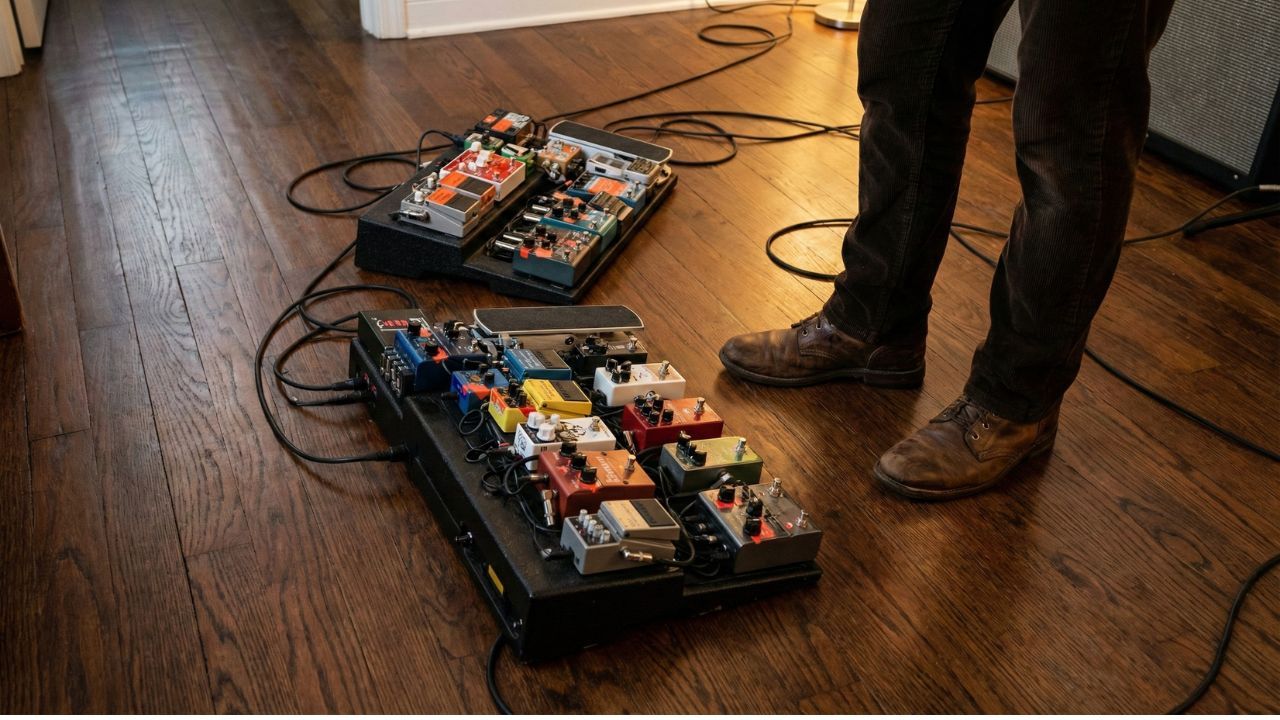
I've been designing pedal circuits for over 20 years, and if I had a dollar for every time somebody asked me for the "correct" pedal order, I could retire twice. So let me clarify that right up front.
The truth is, there's no single correct pedal order. There's a suggested starting order that behaves predictably, and then there are good reasons to move things around based on what you actually want each pedal to do. That's it. That's the whole "secret," though it's really not a secret, it's just common sense.
What I can give you is something quite a bit better than a rule, and that's an understanding of what changes when you move a pedal. And I mean both sound and feel, because that's what really happens when you change the order of your pedals: things sound different, and they feel different under your fingers. Once you have that down, you stop copying other people's pedalboards and start understanding where to put everything to create your own sound.
Definitions
Before we get into the meat of this, here's what I mean when I use these terms.
Compressor - A pedal that grabs the initial attack of your note, squashes it down, and evens out the rest of the signal. It can also bring quieter parts up and louder parts down, basically making everything a consistent volume if you really wanted to. You don't have to use it that hard, though. Some compressors have a clean blend that lets you mix the effect in, because this is one of those pedals that not only sounds different but, probably more importantly, feels different.
Overdrive - A pedal that clips your signal to add harmonic distortion. Clipping is the technical term for what you're hearing when something sounds distorted. A pedal distorts because the signal is clipping. Lower gain overdrives give you a mild breakup, while higher gain overdrives push into distorted territory. A distortion pedal is basically an overdrive that clips harder. It's a more agressive overdrive, in other words.
Booster - A pedal that simply raises your signal level. It's generally thought of as clean, and it might add a little color, but its main job is making things louder.
Fuzz - A heavily clipped, harmonically rich distortion effect. Think of it as three levels of clipping: overdrive is soft, distortion is medium, and fuzz is super clipped. What that means in practice is that fuzz tends to swallow up the whole note and turn it into something completely unique. It's not crunchy like a distortion, it's fuzzy like a fuzz. Fuzz pedals also react to your picking and your guitar's volume knob far more than most overdrives and distortions do.
Wah - A sweepable filter you control with a foot rocker. It emphasizes a narrow band of frequencies and moves that band up and down as you rock the pedal.
Tremolo - A volume modulation effect that pulses your signal up and down at a set rate.
Chorus - A modulation effect that copies your signal, slightly detunes and delays the copy, and blends it back in for a thicker, moving sound.
Buffer - A circuit that converts your guitar's high impedance signal to a low impedance signal. That's the technical version. What it really means is this: with the high impedance signal coming off your guitar, every foot of cable starts affecting your tone. That's actually why coil cables get used on purpose, because they roll off some highs and change the sound of the guitar overall. Put a buffer early in your chain and that effect mostly goes away. The closer the buffer is to your guitar, the less the cable matters. And here's something a lot of people don't realize: plenty of pedals that aren't true bypass have a buffer in them that stays active even when the pedal is off, so you may have buffers in your chain right now without knowing it. There's one catch with all of this: some pedals, especially fuzzes, do not like buffers. A buffer changes how a fuzz sounds, reacts, and feels, which is why the general advice is to put your buffer after the fuzz.
Should a compressor go before or after overdrive?
A lot of people ask this question, and what they usually want is the rule. Here's the answer: there is no rule. If you want to compress your distorted sound, put the compressor after. If you want to distort your compressed sound, put the compressor first.
Now, what does that actually mean? Honestly, it's hard to explain in words. It's something you feel more than something you hear, though you can hear it a bit too. Keep in mind that distortion already compresses a little on its own, and so do overdrive and fuzz. It's just a different type of compression.
Generally, if you run a compressor into a drive pedal (and I'm using "drive" generically here for overdrive, distortion, or fuzz), things sound a bit smoother. The notes are a little more even before they get distorted. If you run your drive into your compressor instead, you keep the natural reaction of those drive pedals. They respond better to your picking dynamics and your guitar's volume knob, meaning you can roll your volume down and clean up easier. The compressor then keeps most everything at the same level on the way out. Play quiet, and it brings that distorted sound up to level. Dig in hard, and it squashes things back down to that same level.
It's a lot like how compression gets used in a recording or mixing situation, where the engineer adds compression on a bus after the fact so everything sits nice and even without big volume spikes. Although sometimes during a song, you actually want those spikes. That's the tradeoff, and it's yours to make.
Stacking boosters and drives: are you adding gain or adding volume?
This is one of the most useful things you can understand about pedal order, because it applies every single time you stack anything.
If you throw a booster before any sort of dirt pedal, that additional signal is going to make the dirt pedal distort more. You're hitting its input harder, so it clips harder. You don't really get much louder, you get more saturation, more compression, and more sustain.
If you throw the booster after the distortion, it just raises the level. The dirt pedal clips exactly the same as it did before, and the booster lifts the whole thing on the way out. Get loud enough and you'll actually start clipping the amp itself, especially with a tube amp. And that's a sound too, a good sound a lot of times. In fact, some of the best clean tones have a tiny bit of dirt on them. Not a noticeable amount, generally, just a little hair on the note that makes everything sound a bit better.
So the practical version is this: booster before the drive gets you more gain, booster after the drive gets you more volume. Whatever pedal comes first is shaping what the second one sees, and whatever comes second is acting on the full output of everything in front of it. That one idea explains most of what happens on a pedalboard.
Why does fuzz usually go first in the chain?
The standard advice is to put fuzz at the very front of your chain, and there's a real technical reason for it, especially with germanium fuzz pedals.
Germanium transistors are sensitive to the impedance of whatever signal they're receiving. Your guitar's passive pickups put out a high impedance signal, and that's what those old circuits were designed around. Put an active pedal in front of a germanium fuzz and switch it on, and you've changed that impedance relationship. The fuzz doesn't like it. It can get thin, sputtery in a bad way, or just plain wrong sounding.
This is where people get tripped up, because they think about bypass types and forget what happens when a pedal is actually turned on. True bypass only describes what a pedal does when it's off. The moment it's on, it's part of the circuit, and it's changing your signal, including the impedance. So even if every pedal on your board is true bypass, kick on a booster or a tuner or anything active in front of your germanium fuzz and you've changed what the fuzz sees, and it may not respond the way you expect. This ties right back to what I said about buffers in the definitions: buffer after the fuzz, fuzz up front where it gets first crack at your guitar.
Some fuzzes are designed to handle buffers and low impedance signals just fine, so this isn't universal. But as a general rule, if you've got a germanium fuzz, let it see your guitar first.
The boost logic from the last section applies here too. A boost in front of the fuzz pushes it into heavier saturation, so it gets crazier and more sustained. A boost after the fuzz keeps the fuzz character and just makes it louder. And there's a nice trick worth knowing: a light overdrive after a fuzz can round off some of the harsh edges while giving you a level lift, which helps a wild fuzz sit better in a band mix.
Compressor, boost, and fuzz together: what order?
This is the question everybody eventually asks once the board grows past a few pedals. If you're running all three, the order most players land on is fuzz first, boost second, compressor third, and there's good reasoning behind each spot.
Fuzz goes first for the impedance reasons we just covered. The boost after the fuzz gives you a way to lift the level or smooth the edges. The compressor at the end of that group acts like a ceiling. No matter what combination of dirt you've got going, the compressor delivers a predictable output level and adds sustain, which makes it a reliable solo lift that doesn't change the character of whatever sound you've built underneath it.
Why not compressor first? Because fuzz is supposed to be dynamic. It reacts to your picking and your guitar's volume knob, and that reactivity is a huge part of what makes a fuzz sound and feel like a fuzz. Put a compressor in front of it and you've squashed all that variation before the fuzz ever sees it. You've removed the very thing that makes the fuzz expressive, and what comes out the other side often sounds more like a generic angry overdrive than an actual fuzz.
The one tradeoff to watch: if you're slamming the compressor with heavy stacked gain, it can flatten your dynamics more than you want. When that happens, kick the compressor off for the dynamic stuff and lean on the boost alone for level changes.
Should wah go before or after fuzz?
Wah before fuzz. That's my favorite way to do it, and I'm not a big fan of wah after fuzz, but let me explain what's actually happening so you can decide for yourself.
A wah is a sweeping filter. When it goes before your fuzz, it filters your guitar signal first and then the fuzz distorts that filtered signal. You stay in the fuzz world the whole time. At no point does it stop sounding like fuzz. The sweep feels integrated with the fuzz tone, like the filter is shaping what the fuzz has to work with, and it stays musical and controlled.
Flip it around and the fuzz builds its full, dense, saturated signal first, and then the wah sweeps across that already distorted signal. Now the wah is emphasizing resonant peaks in a much more dramatic way, because it's working on a harmonically rich, compressed signal. You get big level jumps, things get rattly and harsh, and the sweep starts taking over the whole sound. Some players want exactly that, especially with milder overdrive where it's less extreme. For classic fuzz tones, though, wah first keeps the fuzz intact while adding the sweep on top.
One heads up here, because wah and fuzz is where impedance gets messy in both directions. If your wah does not have a buffer at its input and you run a fuzz in front of it, the wah doesn't really do what it's supposed to do. The sweep isn't right and it just doesn't have the same sound. You combat that by putting a buffer between the fuzz and the wah. Going the other direction, wah into fuzz, it depends on the wah's output. If the wah has a high impedance output, your fuzz can sometimes act a little funky. If the wah has a low impedance output, meaning there's a buffer after the wah feeding the fuzz, you get the buffer-into-fuzz problem I mentioned in the definitions: the fuzz gets crunchier, brighter or darker than it should be, and it starts sounding more like a noisy distortion than a fuzz. That's the tradeoff sometimes. A couple things you can do about it: find a buffer with a tone control and rein the signal in right there, or add a volume pedal after the buffer so you can limit how hard that signal hits the fuzz. Both work, but you're adding another pedal to solve it.
Should delay go before or after reverb?
Delay into reverb. That's what sounds natural to me, and it's the standard for a reason. The delay creates its repeats, and then the reverb places the whole thing, dry signal and repeats together, into the same space. Everything hangs together and sounds cohesive. There's a historical reason your ears expect this too: amps often have built-in reverb, so anybody running a delay pedal into the front of an amp was automatically putting the reverb after the delay. Players have run it that way for decades, and it's baked into the records you grew up on.
Flip it and the reverb builds all its reflections and tail first, and then the delay repeats those reflections. You're delaying the reverb itself, which creates more complex artifacts and a washier, more confused texture. If you're into ambient or progressive stuff and you want things to get a little strange, that's a legit creative tool. For most situations where you want clarity, delay first is the safer bet.
Now, where the dirt sits relative to the delay is its own decision. Van Halen famously ran delay into a distorted amp, which puts the delay before the distortion, and that's a sound as well. You can mimic it a little with a delay in front of a distortion pedal, but you'll notice the repeats get grindier and it doesn't behave the same way it does when the distortion comes before the delay. Distortion before delay gives you clean, distinct repeats of your distorted signal. Delay before distortion means every repeat gets distorted again, and it smears together in that particular way. Neither is wrong, they're just different sounds.
Where should tremolo go in the chain?
Tremolo confuses people because it doesn't fit neatly into the usual "gain first, time-based stuff last" thinking. It's a volume effect, and where it sits relative to your delay and reverb changes the feel more than you'd expect.
Put the tremolo at the very end and it's chopping up everything, including your delay repeats and your reverb tails. Depending on how the tremolo rate lines up with your delay time, that can turn into an uneven, distracting pulse, because the trem is gating your ambience along with your dry signal.
Put the tremolo in front of the delay and reverb and the opposite problem shows up. The trem pulses your signal, but then the delay stacks repeats on top and the reverb fills in the gaps, and the pulse gets partially buried. The effect is still there, it's just less defined.
The sweet spot for a lot of players is delay, then tremolo, then reverb. The delay builds its repeats first, the tremolo pulses that delayed signal so the rhythm of the trem stays clear, and the reverb goes on the end to smooth the whole thing out. There's a reason this feels familiar too. Inside an amp, the tremolo circuit typically sits after the preamp gain but ahead of the reverb tank, and since a delay pedal would've been plugged into the amp's input, a ton of classic tremolo sounds already had delay in front of the trem by default. Run delay into tremolo into reverb and you're recreating a signal flow your ears already know from records.
That said, tremolo at the very end works for some sounds, and plenty of players treat it like any other modulation and put it before the delay and reverb, which is fine. If you've never tried it between your delay and your reverb, though, it's worth an afternoon.
Should chorus go before or after overdrive?
I like chorus after distortion, generally. In that spot the modulation isn't getting compressed and clipped by the dirt, it's acting on the full distorted signal, and you really hear it. The chorusing is pronounced and lush, and if you want that big shimmering sound that defined a pile of 80s ballads and lead tones, that's where it lives.
The exception for me is when I'm using the chorus more like a rotovibe or a rotary effect. For that, I'll usually put it before the dirt, as long as I'm not running a ton of gain. In front of the drive, the modulation gets compressed and clipped along with your dry signal, so it becomes more subtle and more baked into the core tone instead of sitting on top of it. A lot of 80s rigs actually ran chorus into the front of a distorted amp, which is exactly this, and it's a big part of why those tones had that thick, warm movement instead of the more obvious watery chorus sound.
The Boss CE-2 is worth calling out here because it has no mix knob. It's voiced to punch out, and after your drive it can be overwhelming, because there's no way to dial it back from the pedal itself. Moving it in front of the overdrive tames it quite a bit, since the drive compresses the modulation. But understand what you've traded: now you're distorting your chorus instead of chorusing your distortion. Most modern chorus pedals have a mix knob that solves this, but with a classic like the CE-2, placement is your main volume control for the effect.
The starter pedal order
If you're building your first board and want a default layout that behaves predictably, start here:
- Wah
- Fuzz (wah and fuzz interact, see the wah and fuzz section above for how to handle it)
- Univibe, phaser, flanger (modulation that works well before dirt)
- Lower gain overdrive
- Higher gain overdrive
- Boosters
- Compression
- Chorus, pitch shifting, tremolo (modulation that works well after dirt)
- Delay
- Reverb
This is not the "right" order. It's a starting point that works for most players in most situations. From here, the move is simple: change one thing at a time and listen to what happens, and pay attention to how it feels, not just how it sounds.
A few notes on the list. Not all modulation belongs in the same spot. Univibe-type effects, phasers, and flangers generally sound great before your dirt, because the drive compresses the modulation and makes it feel like part of your core tone. Chorus, pitch shifting, and tremolo usually sound better after the dirt, where the effect is more pronounced. Those aren't hard rules either. Univibe after dirt sounds different, and different might be exactly what the song needs.
The overdrive order matters too. Running a lower gain overdrive into a higher gain one is a great way to push that second stage into more saturation while keeping things musical, and you can absolutely flip it depending on what you're after. Same principle as everything else in this article: whatever comes first is shaping what the second pedal sees.
Some adjustments to try once you've got the basics down: move the compressor before your drive if you want smoother, more even notes going in. Try tremolo between your delay and reverb if you want the pulse rhythmic and clear. Move your booster behind the overdrive if you need volume for solos instead of more gain, and don't be afraid to let it push the front of a tube amp a little while you're at it.
The whole point is understanding the tradeoffs. Once you know what each placement changes, in sound and in feel, you stop copying other people's boards and start building your own.
FAQ
Q: Does pedal order really matter that much? A: Yes, but not in a "there's one right answer" way. Every pedal in your chain is either shaping what the next pedal sees at its input or processing what the previous pedal already did to your signal. Changing the order changes that relationship, which changes the sound and feel. Some swaps make a subtle difference, and some completely change the character of your tone. The point is to understand what's happening so you can make intentional choices.
Q: Why does my fuzz sound weird when I put other pedals in front of it? A: This is almost always an impedance issue, especially with germanium fuzz circuits. Some fuzz circuits with transistors are designed to see the high impedance signal from your guitar's passive pickups. When you put an active pedal in front of the fuzz and switch it on, it changes the impedance to something the fuzz wasn't designed for, therefore it sounds different. The fix is to put the fuzz first in your chain, before any buffered or active pedals. Note that not all fuzz pedals are sensitive to this.
Q: Should I put my compressor before or after my overdrive? A: It depends on the job you want the compressor to do. Before overdrive, it evens out your dynamics and pushes the drive into smoother, more saturated clipping. After overdrive, it controls your output level and adds sustain without changing the drive character. If you're playing through a cranked amp and need a solo boost that actually cuts through, try the compressor after your drive.
Q: Where should wah go in my signal chain? A: Wah typically goes at the very beginning of the chain. If you're running fuzz, wah before fuzz is the standard recommendation. This keeps the fuzz character intact while the wah shapes the input signal. Wah after fuzz creates a much more dramatic, aggressive sweep that can cause level jumps and harshness, which some players want for specific sounds but most find too extreme for normal use.
Q: Is delay before reverb always better? A: Not always, but it's the more natural, predictable result for most playing situations. Delay first creates repeats and then reverb places everything in a space. Reverb first creates reflections that then get repeated by the delay, which produces a more complex, washy, and potentially confused sound. Most players prefer delay before reverb, but reverb before delay can be a great creative choice if you like experimental, ambient textures.
Q: Where does tremolo go on a pedalboard? A: Tremolo placement is more flexible than most effects, but a strong default is between your delay and your reverb. This keeps the trem pulse rhythmic and clear while the reverb smooths the result. Tremolo after everything can work but may chop up your delay repeats and reverb tails in a way that feels messy. Tremolo before delay and reverb can get masked by the wet signal filling in the gaps.
Q: Should chorus go before or after distortion? A: After distortion is the more common and usually preferred placement. When chorus is after your dirt, the modulation is pronounced and you can clearly hear the effect. Before distortion, the overdrive compresses the chorus and makes it much more subtle and integrated. That can be cool for a specific warm, thick sound, but most players rarely put chorus before their drive because you lose a lot of the effect. Pedals without a mix knob, like the Boss CE-2, are especially sensitive to this choice because you can't dial back the intensity from the pedal itself, so placement before drive becomes your main way to tame it if it's too much.
Q: Can I run my booster before and after my overdrive? A: You can, and many players do with separate boost pedals in different chain positions. A booster before your overdrive pushes the drive into more saturation and compression. A booster after your overdrive raises the output level without changing the drive character. Having both options available gives you the ability to add more gain for rhythm parts and more volume for leads without changing your core drive sound.
Q: What if I break the suggested pedal order and it sounds good? A: Then you're doing it right. The suggested order exists because it tends to behave predictably for most players in most situations. But there are professional players all over the world running delay before distortion, reverb into driven amps, and all kinds of "wrong" orders because it works for what they do. The suggested order is a starting point for understanding, not a rulebook. If it sounds good, it is good.
Q: My fuzz sounds weird with my wah in front of it. What's going on? A: Some wah pedals have a buffer built into them, and that buffer changes the impedance of the signal before it hits your fuzz. Certain fuzz circuits, especially germanium designs, don't respond well to that low impedance signal. The result is a fuzz that sounds thin, weak, or just wrong. If you're running into this, you have a few options. You can try running the fuzz before the wah, you can look into a wah that's designed to work with fuzz pedals, or you can use a fuzz that's more tolerant of buffers. It's a compatibility issue between specific pedals, not a universal rule, so it's worth knowing what your particular wah and fuzz are doing to each other.
Q: Do univibe, phaser, and flanger go in the same spot as chorus? A: Not necessarily. Univibe-type effects, phasers, and flangers generally work well before your dirt because the overdrive compresses the modulation and makes it feel more integrated into your core tone. Chorus, on the other hand, usually works better after dirt where the effect is more pronounced. That said, univibe and phaser after dirt sound different but not bad. It depends entirely on the sound you're going for. The key difference is that chorus tends to lose too much of its character before dirt for most players, while univibe and phaser-type effects can thrive in that position.